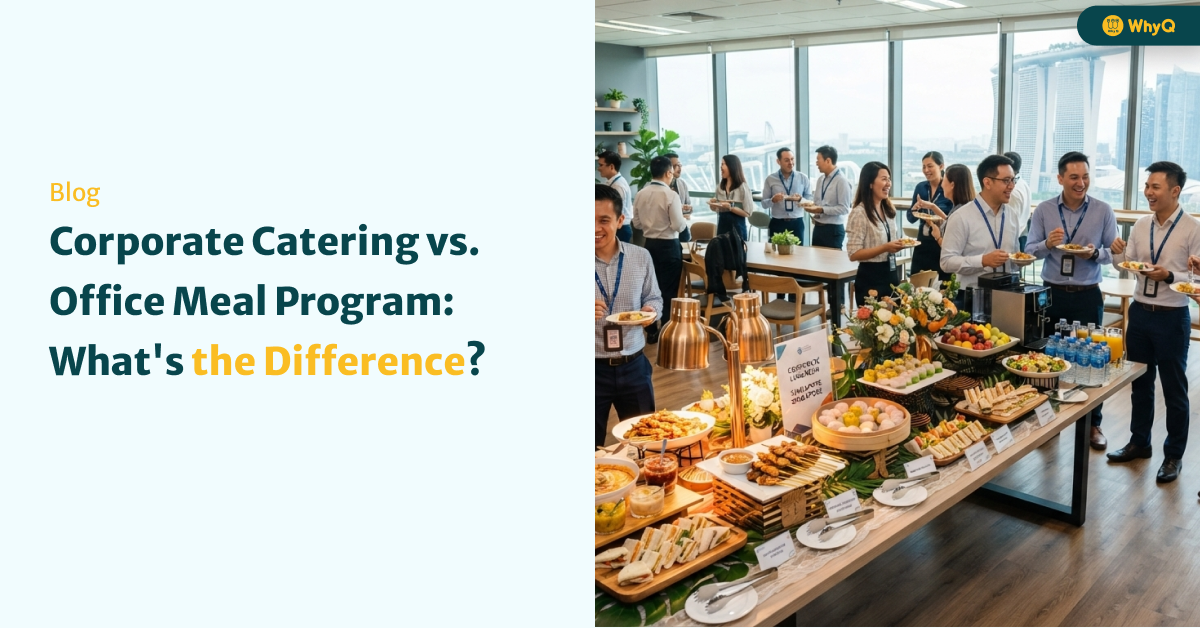
While the terms "corporate catering" and "office meal program" are often used interchangeably, they serve distinct strategic functions in the workplace. Corporate catering is an event-based, ad-hoc solution designed for special occasions, client meetings, town halls, or celebrations, typically utilizing buffets, live stations, or set bento boxes. In contrast, an office meal program is an ongoing, daily or weekly infrastructure aimed at employee well-being, morale, and productivity. It leverages customizable employee portals to offer scalable, individualized daily food choices. Modern Singapore organizations benefit from adopting a hybrid model that combines both approaches. Platforms like WhyQ streamline both needs under a single platform with consolidated billing and access to over 2,000+ local hawkers and restaurants.
When HR professionals, office managers, and business leaders start looking into food solutions for their workplace, terms like "corporate catering" and "office meal program" are often used interchangeably.
However, they serve entirely different purposes, involve different logistics, and cater to distinct workplace needs. Understanding the difference between the two is crucial for choosing the right food solution, managing your budget effectively, and truly driving employee satisfaction.
Let’s break down the definitions, use cases, and benefits of both options in the Singapore corporate landscape.
Traditional corporate catering refers to food service arranged for specific, often ad-hoc events, meetings, or gatherings. It is project-based rather than routine.
Think of it as catering for a specific moment in time when you need to feed a group all at once, usually with a standardized setup.
Typical Use Cases: Board meetings, client presentations, annual town halls, product launches, department celebrations, and holiday parties.
Format Options: Full-service buffet setups, interactive live food stations, or large batches of individually packed bento catering.
The Goal: To impress guests, nourish attendees during a conference, or celebrate a specific company milestone. It is designed to be memorable, structured, and event-focused.
An office meal program (often structured as recurring daily or weekly office lunches) is an integrated, ongoing operational perk. Instead of ordering for a special event, you are building an ongoing food infrastructure to support your workforce day in and day out.
Typical Use Cases: Daily office lunches, regular weekly team huddles, hybrid-work coordination days, or recurring "Lunch & Learn" sessions.
Format Options: Flexible, scalable daily meal schedules utilizing a customizable employee ordering portal where staff can choose their preferred meals.
The Goal: To solve the daily "What's for lunch?" dilemma, boost employee retention, maintain productivity, and foster daily social connection in the office break room.
| Feature | Corporate Catering (Events) | Office Meal Program (Daily) |
| Frequency | Ad-hoc, one-off, or occasional | Recurring (daily, weekly) |
| Primary Audience | Clients, entire company, or event attendees | Internal teams, departments, or total workforce |
| Flexibility | Fixed menus, bulk quantities, set schedules | Highly customizable, individual choice, scalable headcounts |
| Main Objective | Event success, hospitality, or celebration | Employee well-being, retention, and routine convenience |
| Logistics | Event setup, teardown, and on-site service | Streamlined daily office lunch delivery |
While they serve different functions, successful modern workplaces in Singapore often utilize a hybrid approach.
Relying solely on ad-hoc catering means your team lacks daily structure and nutritional support. Conversely, relying only on routine daily meals leaves you unprepared when you need to host a high-stakes client meeting or a company-wide town hall.
The secret lies in choosing a flexible partner that can handle both seamlessly.
Whether you need a massive multi-vendor buffet for a corporate event or a seamless, daily office meal plans Singapore setup that lets every employee pick what they love, you don’t need two different vendors.
WhyQ bridges the gap between daily sustenance and special events. With access to over 2,000+ hawkers, restaurants, and caterers, you can effortlessly scale from daily individual bentos to high-end corporate buffets—all managed through a single platform with consolidated monthly billing.
Ready to streamline your office food strategy? Contact WhyQ today to design a flexible corporate catering or daily meal program tailored to your company's exact needs.